
Coffee industry’s top tech stories in 2025 Part 3: Internet of Things (IoT), Blockchain, Augmented Reality
Perry Luckett, CoffeeMan1
In our last blog post, I covered how artificial intelligence (AI)-driven quality control can improve each stage of coffee production in 2024 and beyond. Today’s topic discusses three other major enhancements for coffee production:
Internet of Things (IoT) technologies, which use sensors and monitoring systems to collect data vital to coffee production and distribution
Blockchain technologies that automate data collection, recording, and storage throughout the supply chain
Augmented reality, which instantly superimposes computer-generated digital information—such as images, sounds, or other sensory inputs—onto the real world. It gives growers a highly accurate way to locate and identify issues and solutions within milliseconds of their occurrence.
Internet of Things (IoT) technologies: collecting data for improved production
Internet of Things (IoT) sensors and monitoring systems are reshaping coffee production. These technologies allow growers to optimize such production aspects as harvesting techniques, roasting profiles, and packaging methods. They enable producers to automate processes, reduce waste, and improve efficiency while also enhancing product quality control.
IoT is a network of physical devices, interfaces, and other items embedded with sensors, actuators, electronics, and connectivity. These devices collect data from their environment through IoT sensors and communicate it to systems. Data from IoT sensors can be used to better understand a system or process for further actions. It can also prevent tragedies, decrease usage costs, and simplify our everyday lives.
IoT sensors are one of the key parts of IoT devices that collect data from surroundings and transmit it over networks. IoT sensors are electronic chipsets or modules that sense ambient or system conditions and transmit that data to the Internet through a gateway. These different sensors can function through physical contact, radiation, or magnetic fields.
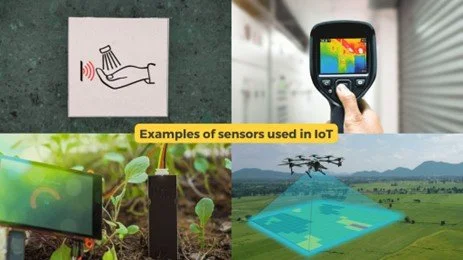
Two main types of sensors are used in IoT applications. Passive sensors detect changes in their environment, such as temperatures, without any dedicated power supply. Active sensors require batteries or some other form of power source to function. In a nutshell, IoT sensors measure the physical environment to collect data about things like temperature or air quality; they can then transmit the information via a network to gateways and the cloud. Once in the database, it can be analyzed further for the next course of action. [KG, MN]
An example of IoT use in the coffee industry is the way coffee producers in Brazil apply sensors and other monitoring systems to collect and analyze data immediately. This technology helps producers adjust harvesting techniques, improve harvest timing, and manage crops for better yield and quality. IoT sensors and monitoring systems are deployed to track environmental conditions such as temperature, humidity, and soil quality. This data helps produce the best growing conditions and improve crop yields by immediately adjusting irrigation and fertilization processes. [CO, CI]
IoT and coffee production: applications and benefits
Overall, integrating IoT (Internet of Things) into coffee production transforms the industry from farm to cup, driving efficiency, sustainability, and quality control through real-time data and automation.
Smart agriculture for coffee farms
Monitoring soil and crops: IoT sensors track soil moisture, pH levels, temperature, and nutrient content for best growth conditions. This reduces over-irrigation and ensures healthier crops.
Monitoring climate: Weather stations and environmental sensors provide live data on rainfall, temperature, and humidity, allowing for timely decisions on irrigation, shade management, and frost protection.
Detecting pests and diseases: Early detection of diseases, such as Coffee Leaf Rust (Hemileia vastatrix), uses connected sensors and AI analysis to reduce crop loss and reliance on pesticides.
Example: The World Coffee Research Institute promotes digital tools, including IoT sensors, to combat coffee diseases and climate challenges. [WCR]
IoT in the coffee supply chain
Traceability and transparency: RFID tags, GPS trackers, and blockchain-linked sensors track coffee from farm to export, ensuring quality control and ethical sourcing.
Real-time transport monitoring: Sensors monitor humidity, temperature, and handling conditions during bean transport, preserving the green beans’ quality.
Example: IBM's "Farmer Connect" project uses IoT and blockchain to trace coffee beans from farm to consumer, so everyone can see what is happening to the coffee [IBMN]
IoT in coffee processing and roasting
Precision roasting: IoT-enabled roasters adjust temperature, airflow, and time based on real-time feedback, ensuring flavor consistency and reducing waste.
Predictive maintenance: IoT devices monitor roasting and processing equipment, predicting failures and scheduling maintenance to minimize downtime.
Example: Companies such as Bellwether Coffee integrate IoT into electric coffee roasters for remote control, data tracking, and best quality. [BC]
Smart coffee machines and consumer experience
IoT-enabled coffee makers: Connected coffee machines allow remote operation, personalized brewing settings, and predictive maintenance alerts for cafes and consumers.
Tracing by consumers: QR codes and apps linked to IoT data offer consumers origin details, sustainability information, and quality assurance.
Example: Nespresso’s AAA Sustainable Quality Program uses IoT to support more than 100,000 farmers by providing live data and monitoring supply chains.
IoT technology is promoting efficiency, sustainability, and quality in the coffee industry. From smallholder farms to global roasters, IoT enables data-driven decisions, higher yields and crop quality, automated monitoring and maintenance, greater clarity across the supply chain, and better coffee for everyone.
Internet of Things sensors and monitoring systems are also reshaping coffee production. These technologies allow growers to use the best harvesting techniques, roasting profiles, and packaging methods. They enable producers to automate processes, reduce waste, and improve efficiency while also strengthening product quality.
Blockchain technology: making coffee supply chains transparent and traceable
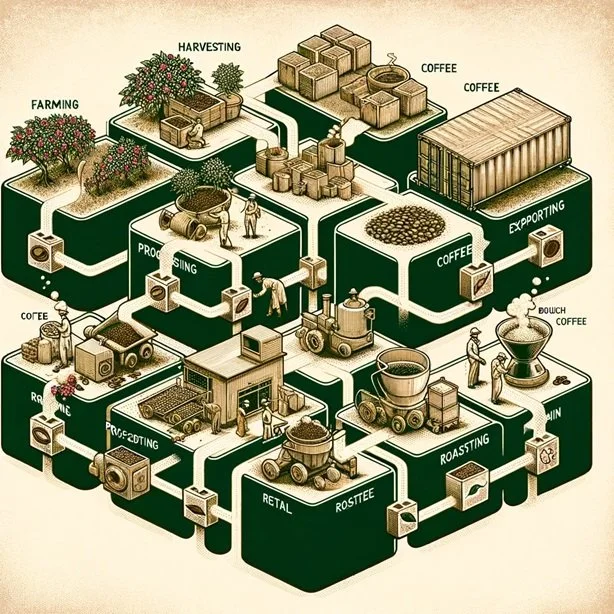
Diagram showcasing the various stages of coffee production in a blockchain format. Each block represents a different phase in coffee production, from farming to retail, connected in a sequence to illustrate the traceability and transparency of the system.
Blockchain technology has greatly benefited coffee production. Here's how it works and its benefits:
Decentralized ledger: Blockchain is a distributed-ledger technology, which means data is stored across several nodes in a network. Each block contains a time stamped record of transactions, and once recorded, the data can’t be changed retroactively without altering all subsequent blocks, ensuring the data remains permanently in the system.
Traceability: Every step of the coffee supply chain, from cultivation to consumption, can be recorded on the blockchain. Each transaction, such as harvesting, processing, packaging, and shipping, is time stamped and added to the blockchain, creating a permanent record of the coffee's journey.
Transparency: Participants in the coffee supply chain—farmers, processors, exporters, importers, roasters, and retailers—can use the blockchain to view real-time information about the product's origin, production methods, and handling practices. This transparency fosters trust and accountability among shareholders, customers, suppliers, and employees.
Origin verification: Blockchain enables consumers to verify the authenticity and origin of coffee products. By scanning a QR code or accessing an online platform, coffee drinkers can trace the coffee back to its source, learning about the farm where it was grown, the processing methods used, and other relevant details.
Quality assurance: In addition to traceability, blockchain can also store data related to quality control measures, such as sensory evaluations, chemical analyses, and certification documents. This information provides assurance to consumers regarding the quality and authenticity of the coffee they purchase.
Efficiency and cost reduction: Blockchain streamlines supply chain processes by eliminating the need for intermediaries and manual record-keeping. Smart contracts or “self-executing” contracts write agreement terms directly into code. The terms automatically enforce themselves when specific conditions are met, without human intervention or further action. These automated transactions and payments reduce administrative costs and improve efficiency.
Fair trade and sustainability: Blockchain can support initiatives such as Fair Trade and sustainable sourcing by transparently documenting fair pricing, premiums paid to farmers, and compliance with environmental and social standards. This visibility empowers consumers to make informed choices aligned with their values.
Risk mitigation: By providing a tamper-proof record of transactions, blockchain reduces the risk of fraud, counterfeiting, and adding inferior beans to the coffee supply chain. Any attempt to alter data would require consensus among the network participants, making fraudulent activities more difficult to carry out and conceal.
Overall, blockchain technology holds promise for revolutionizing the coffee supply chain by enhancing transparency, traceability, and trust among stakeholders, ultimately benefiting both producers and consumers.
Augmented reality: helping producers troubleshoot production problems
Augmented reality (AR) superimposes computer-generated digital information—such as images, sounds, or other sensory inputs—onto the real world in real-time. It enhances our perception of reality by adding virtual elements to our physical surroundings. These technologies offer a highly accurate way to locate and identify issues within milliseconds of their occurrence, as well as detailed instructions on how to resolve them. Thus, AR technologies lessen downtime and ensure consistent, reliable production. [CO]
Using augmented reality for troubleshooting also enables coffee producers to take advantage of advanced data analytics. By collecting data about their production processes, producers can gain valuable insights into efficiency, cost savings, and other factors that are critical for success. They can use this data to create a roadmap for upgrading operations and ensuring long-term profitability.
Finally, by using augmented reality technology for troubleshooting, coffee producers can ensure their staff is better equipped to handle unexpected problems. With detailed instructions readily available, employees can quickly apply solutions without having to rely on guesswork or manual intervention. This helps improve overall productivity while reducing costly mistakes. All of these benefits make augmented reality an invaluable tool in modernizing coffee production.
Augmented Reality in Coffee Production
AR can significantly improve coffee production in the following areas:
Farm Management
Crop monitoring: Farmers can use AR to visually assess the health of coffee plants. By scanning fields with AR devices, they receive real-time data on plant health, moisture levels, and potential diseases.
Identifying pests and diseases: AR applications help identify pests and diseases by overlaying information about symptoms and providing potential solutions.
Training and education
Training farmers: New farmers can use AR to learn best practices for planting, nurturing, and harvesting coffee. Interactive guides can provide step-by-step instructions.
Developing skills: Workers receive real-time feedback while performing tasks, improving efficiency and skill levels.
Quality control
Processing and sorting: AR helps processing by providing visual cues for sorting coffee beans according to quality standards.
Inspecting: Inspectors can use AR to visualize and compare beans with quality benchmarks, ensuring consistent product quality.
Supply chain and logistics
Managing inventory: AR can track and manage inventory levels, providing real-time updates and visual representations of stock.
Improving logistics: Overlaying route information and delivery schedules can streamline logistics, ensuring timely deliveries.
Marketing and consumer engagement
Product information: Consumers can scan coffee packaging with AR-enabled devices to access detailed information about the product’s origin, flavor profile, and brewing tips.
Interactive experiences: Coffee brands can create AR experiences for customers, such as virtual coffee tastings or farm tours, enhancing engagement and loyalty.
Industry leaders believe augmented reality technologies can revolutionize coffee production by sharpening efficiency, improving quality, and providing valuable training and educational resources. By integrating digital information with the physical world, AR can offer innovative solutions to the coffee industry’s challenges.
This article completes my review of major technological improvements that are appearing or planned for the coffee industry—all intended to deliver a better-quality product to you. These technological advancements not only improve efficiency and product quality but also contribute to more sustainable production practices by reducing waste and pollution. Modern coffee production, driven by these technologies, marks a significant shift in the industry, promising higher quality products, cost savings, and a more sustainable future [CO].
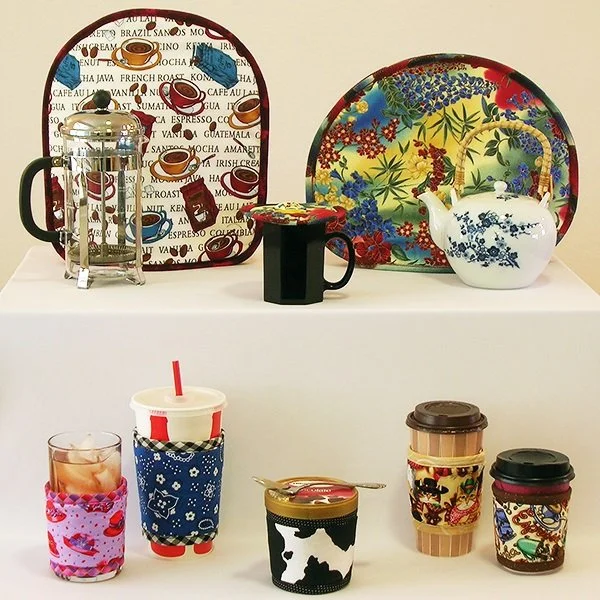
For nearly 30 years, Koffee Kompanions™ has offered the best French press and teapot cozies, cup covers, hot or cold drink sleeves, and ice-cream pint cozies in the world.
At Koffee Kompanions™ Inc. we combine high tech and high touch to produce the best French press and teapot cozies, cup lids, cup wraps (sleeves), and ice-cream pint sleeves on the market. Thinsulate™ insulation by 3M™ provides the tech—keeping your drinks hotter or colder up to three times longer than other insulated products. High-quality fabrics, lots of fabric designs and colors, and superior workmanship supply the touch.
Resources
Britannica, “Augmented Reality,” https://bit.ly/3JHpRg4, October 17, 2025.
Kasia Gerlée, 16 Types of Sensors Used in IoT, https://bit.ly/4ooGKLG , February 24, 2023 (updated March, 2024). [KG]
Interaction Design Foundation, “What Is Augmented Reality,” https://bit.ly/3JHpUZi , 2025.
Justin, “Revolutionizing Coffee Production: Exploring The Latest Technology Trends,” https://bit.ly/4omBHvd , October 20, 2023. [CO]
Minewstore, “16 Types of IoT Sensors: Exploring Their Functions and Applications,” https://bit.ly/4op13bT , October 25, 2024. [MN]
Wikipedia, “Augmented Reality, “ https://bit.ly/47no4pv , October 22, 2025.